You Shall Find My Vanities Forespent: A Draft

You hold who I was, frozen in time. He is but a corpse no longer among the living. How far has he journeyed from you. How much more has he become.

O, how watchful have I been to see you unmoved. Settled like silt along the banks of fetid waters; deeply rooted like thorns underfoot.

Here we stand. Host of the dead and I. Bear you now your arms, for neither can live while the other yet draws breath. Come and find my vanities forespent.

Fertilized Wine and a Side of Genocide: My People Have Much to Atone For

Slurs are a slurry of swill.
Urine and feces
Served at wine tastings.
Their bottles are fermented.
Ours are fertilized.
Drink up.
It’s poison,
And we’re all gonna die.

Forgive all this white noise.
It’s just my religion.
A holy mission
To put women back in the kitchen.
Because I need a sandwich in this man’s world.
So break out the casseroles,
And there better be raisins
In that potato salad.

We conquered the world
Just to dump its spices into the ocean,
Like tea
On a balmy Bostonian day.
If we can’t handle it,
No one gets to have it.

White pride.
It’s a precursor to genocide.
We’ve shackled dark skinned bodies
And forced entire cultures to die.
Go ahead,
Write it down, it doesn’t matter,
We’re burning entire libraries alive—
With all the great works still inside.

So drink up—
To the new world we’ve civilized.
Or, colonized.
Shout out to Jesus Christ!

Bathsheba: Beloved of God–Examining 2 Samuel 11 & 12

There was something refreshing about the evening air in springtime. Much of the day had been put behind her save for those last nagging thoughts that tend to linger upon uncertainty. It was the season of war, and hubris pitted nation against nation (2 Sam 11.1). Her husband was among those fighting another man’s battle for glory–taken in by the illusion that bloodshed somehow brought honor or made men great (11.11). Fool, but still, she loved him (12.3; Kensky 155). Like the evening air, the water was cool and invigorating, providing respite in the midst of a tumultuous season. She was unaware of the gaze that held her like an object to be owned or the hunger rising behind those lurid eyes (2 Sam 11.2-4). When the king’s men arrived, Bathsheba had no recourse. Hers was but to submit.

—–

The structures of power are aligned against Bathsheba. To position her as villain or vixen in the account of 2 Samuel requires leaps the text does not provide. Neither does the Hebrew provide wiggle room to frame David as the unwitting victim of feminine wiles. In the clearest (and least academic) terms, based on what is revealed in the text, Bathsheba was minding her own damn business. It is David’s lustful eyes that happen upon her private moment, and it is David who sexualizes and objectifies her body. Like Simba, who disregarded Mufasa’s warning that the dark places were not his to tread, David considers all he lays eyes upon to be his, for he is king. Therefore, he sends his messengers into the shadowlands beyond divinely established moral borders to take what does not belong to him.

David does what David does because he believes he can. He is king; who can challenge him? There is no hard evidence to prove that his audience with Bathsheba was anything more than a friendly chat. Rumors, after all, are only rumors. It is when Bathsheba becomes pregnant that things get a little more complicated. David can’t just shove $600 into her hand and tell her to “take care of it.” Instead, he does the next worst thing–he brings her husband home for a bit of r&r in the hope of hiding the truth surrounding Bathsheba’s condition. When that doesn’t work, the king murders her husband by proxy.

What transpires between Bathsheba and David is a sexual assault. Regardless of how force, intimidation, or coercion may have been used, the encounter remains an assault. From the moment the male gaze of David falls upon her, Bathsheba’s life is in danger. She cannot refuse the king, for he can put her to death (or worse). If her husband discovers she is pregnant and he a cuckold, he can put her to death to restore his fragile honor. The power differential is far too vast for Bathsheba to cross safely.

Bathsheba is damned if she does and damned if she doesn’t. Her personhood is violated by a prick in a crown. She has no earthly means of getting the justice due her. Her assault and the murder of her husband go unresolved because the structural powers are set against her. Yet, the unfathomable injury against her does not go unanswered. The Divine Creator of the universe sees the harm brought against the “least of these” (Mt 25.31-46) and is enraged. Bathsheba, bearing the imago dei, has been grossly injured and God is not having it–not today, anyway.

—–

This divine intervention reveals that our sacred cows do not always get it right–they don’t even get it mostly right. Yet, because we do not want to critique our idols, we miss what is happening before us. To frame this story as “what you do doesn’t matter as long as you love God” is to miss Bathsheba. The man after God’s own heart inflicts undue trauma on her. As Tikva Frymer-Kensky suggests in Reading Women of the Bible, Bathsheba–and not her husband–is the poor man whose lamb is taken and slaughtered (155). The “thing that David had done displeased the Lord” (2 Sam 11.27) and he is held accountable.

God loves Bathsheba. Though her society makes her lesser because of her gender and renders her male property, the Creator’s action casts her in a different light. The Divine brings judgment down on the king’s head for her. Her personhood and dignity matter. She bears the same imago dei as her male counterparts. God equally loves her.

This divine act almost seems to foreshadow the coming Christ, who will fulfill the Law and tear down the barriers erected to segregate us from each other–in whom there is no distinction between “us” and “them.” Certainly, this should call to mind the foundation of the Law and Prophets–to love God with all we are, and to love the human beings around us as we ought love ourselves (Mt 22.36-40) regardless of the segregating barriers culture would have us erect. BIPOC, LGBTQIA+, female, male, poor, rich, homeless, disabled, white, cisgender, heteronormative, non-heteronormative, and everything in between, in Christ, we are one, and by our love we will be judged (Mt 25.31-46).

Perhaps, then, it is imperative that we strive to see the overlooked among us—for regardless of our own perceived standing before God, we will be held to account where we withheld love in favor of cruelty and self satisfaction.


It Hurts to Be, Sometimes…

One time, I had a real moment of honesty with my psychiatrist. I told him about the manic episodes, the physical exhaustion, the pain that comes with every crash. I said, “I just want to give up.”

He asked me what I meant, and I assured him I didn’t mean suicide. Simply, I feel done sometimes. I want to quit. Just not do anything.

When he still didn’t seem to understand I explained to him that at some point long, long, ago my sperm donor had given up. He quit. He just one day parked himself in front of his computer and played Microsoft Flight Simulator for decades. His family, his responsibilities, his obligations didn’t mean dick to him. He took on the role of “absence-interrupted-by-moments-of-violence.” He played it well.

My psychiatrist asked me what it was that kept me going. I told him, “I don’t want to be that man. I have a family that depends on me. So, I just take on everyday as best I can—no matter how much it hurts.”

And that is how I’ve felt for so long. Overwhelmed. Suffering chronic pain most days. My head is chock full of ghosts. I feel alone sometimes. I want to quit, but I force myself to keep going. If I fail, I let everyone down and I become just like my sperm donor.

My psychiatrist has since referred me to a team of specialists. He thinks I need to unravel the rat’s nest of trauma still tangled up on my insides. Maybe he’s right. Still, there are days I want to quit.

Today I was Diagnosed with Bipolar Disorder: And I Found the Words I Have Spent Decades Searching For

Two hours going over issues of severe dysfunction resulted in a diagnosis that changes my entire treatment plan. Not only will the change in plan completely transform treatment, but the current mode of treatment has, in fact, made the issue much, much, worse.

The words “type 1” and “rapid cycling” were used. My disordered sleeping patterns marched in lockstep with what he’d come to expect. A number of other markers came to light, but the “oh!” he exclaimed came as the precursor to an explanation of severity for which neither us foresaw.

Towards the end of the assessment he asked how I was able to have a successful career in the Navy for 15 years, if I had been experiencing “all this?”

I sat for a while with his question. I rolled it around in my head, wondering at it. Instinctively, I wanted to say “because I had to.” That answer, however, was only a symptom of a greater wound.

I said, “sir, I am an expert at masking. I am deeply in tune with the unspoken language of others. It troubles me how accurate my assessment of a person’s current state, and the outside influences affecting that state, often are. I developed this skill from a young age, where I—a child—was responsible for the moods, actions, and reactions of the ‘adults’ in the home.”

I said, “my sperm-donor would fly into a fit of violent rage at anything that disturbed him. A noise unintentionally too loud, a distraction from the endless hours spent pretending to be the pilot he never became, or simply words he didn’t like would drive him to unpredictable violence. I spent a long time afraid for my life.”

“His attention” I continued “when it wasn’t violent was often cruel. He belittled us, shamed us, bullied us—and if we protested, violence would accompany cruelty.”

I told the doctor, “I had to learn how to read people for my safety, and for the safety of my younger siblings. I had to mask and not bring the adults my worries, my hurt, or my suffering. That was not what parents were for—it was the job of the child to carry the burdens of the adults—or so they had taught me.“

Finally I said, “this is why I am good at knowing how to provoke and draw attention to myself. It was the only tool I had to protect my siblings when the monster stirred to life. It is the reason I am quick to react when I see the defenseless being harmed by the dumb and powerful. It’s why I am quick to come to the aid of the defenseless because I can bear the hurt and the pain. I can give them opportunity to seek safety…

“…Honestly, it is what made me especially good at what I did in the Navy.”

Juneteenth Liturgy this Sunday!

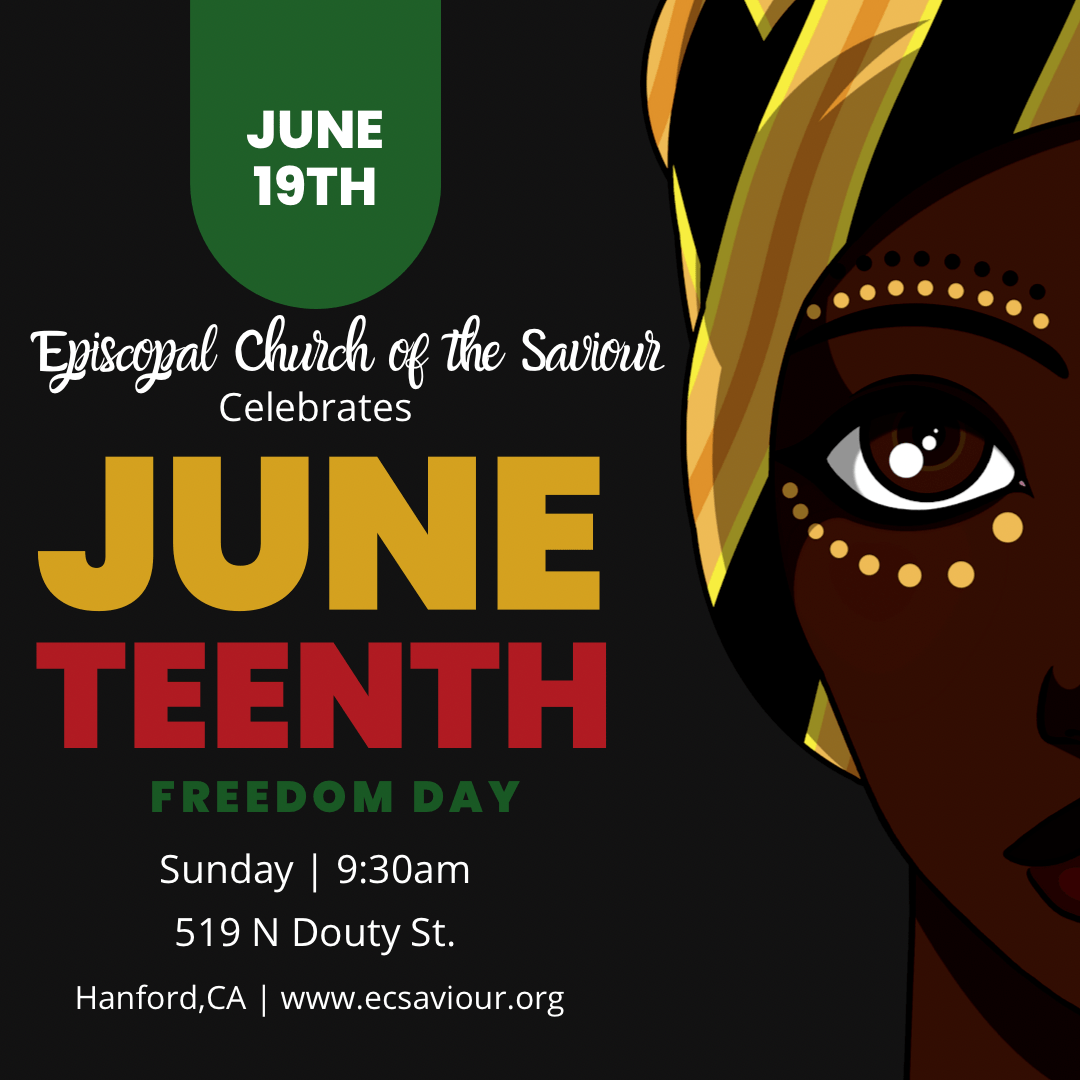
Episcopal Church of the Saviour will be celebrating a Juneteenth liturgy this Sunday, June 19, 2022 at 9:30am! If you’re in area come out and celebrate Freedom Day!

Juneteenth: Freedom Day

“May God bless us with enough foolishness to believe that we can make a difference in this work, so that we can do what others claim cannot be done. Amen.”

Franciscan Four-Fold Blessing, The Very Rev. Kim L. Coleman.