Dark Places and Blind Guides: Reflecting on the American Apocalypse and the Anxieties of New Birth

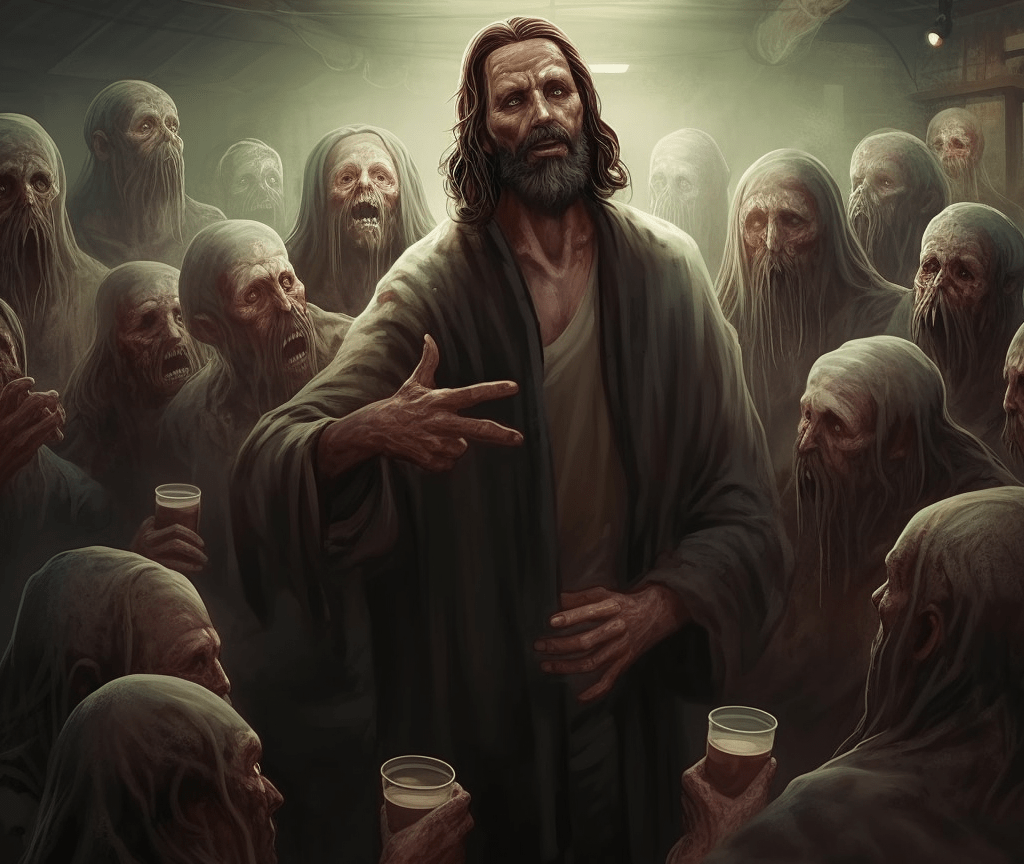
We are in a dark place navigating new spaces, renegotiating our understanding of the world, and striving to find the light. Blind guides rise like the priests of vengeful gods to direct us back into the darkness from whence we have emerged. We are surrounded by so many false guides claiming to hear the voice of a holy Spirit, but the Spirit isn’t holy–it is Fear.

The old world strains to hold itself together, refusing to believe that it is the shell the new world must shatter in order to be made manifest. The earth and her people cry out for hope, mercy, and a better way, but the better way demands a reckoning with the diseases we allowed to infect us like Cancer.

For too long, we have been content to allow selfish desire to motivate the direction of our world–selfishness that benefits the few while the many suffer. We are divided in every way imaginable, and many of us have been fooled into believing that we are not the same. But we are.

Regardless of how we look, sound, and love, we are the same. Beautifully diverse but still the same. And yet, we have used that diversity to fuel conflict between one another and to justify the inexcusable suffering we have been content to ignore.

Covid-19 crossed every boundary we put in place to divide ourselves. It killed indiscriminately. Our ethnicity, race, religion, political ideology, and every other point we cling to feign superiority did not save us. America, for all its claims to exceptionalism, was not spared. In fact, it led the developed world in preventable losses.

Covid-19 was not evil. The virus acted according to its nature, finding hosts, feeding, and reproducing. Covid was what it was, but for us, we can argue that it had been a test. A test we failed miserably. Like an apocalypse peeling back the world we know to bring revelation, Covid revealed–for all our posturing and talk–we were incapable of loving our neighbor.

The inability to love our neighbor as we ought to love ourselves is the disease from which our symptoms of hate and bigotry bubble to the surface. The institutions that speak of a God, a savior, and divine love as the cure for our sickness proved to be havens for our worst symptoms. The curtain was drawn back to reveal the devils behind it, and now they scramble to expedite their grasp for power, violating each commandment they insist we uphold.

Now, a choir of voices emerges to demand the exorcism of every devil in every institution and constructed system that uplifts a privileged few on the backs of the many. The elite insists their positions have been acquired by “merit,” but this so-called merit is little more than a coat of white paint covering stone crypts filled with dead bones. The emergent choir, the rightful heirs, demands a better way to meet the needs of all people, not just the needs and desires of the few who have cheated their way to power.

The call to dignity and the just treatment of all people has been resisted by blind guides and their misguided flocks. They are afraid of the loss equality will demand they absorb, such as sharing the commons with those who live and look differently from themselves. Symbols of hate, intolerance, and violence are among their banners; foolishly, they call these things love. And yet, to live according to their interpretation of love requires the death and destruction of those unwilling to conform to the conditions of their “unconditional” love.

In America, many people invoke the name of Jesus Christ to justify their resistance to what Jesus called them to observe. Biblical illiteracy and raving antichrists have profaned the sacred; their holy water is poisoned. Once again, the house of the Divine has become a den of thieves who steal, kill, and destroy. Woe to them and their blind guides who stand condemned lest they repent.

These same amplify their voices to create an illusion that theirs is the voice of reason, yet heeding them has yielded only economic, ecological, and social despair. These blind guides demand we return to the darkness, calling it, making whatever ideal “great again.” Darkness has never been great. It knows this, and it is why it fears the exposure the Light shall bring. Banning books, denying history, calling truth lies, and withholding education from as many as possible are the desperate strategies of those afraid of what the light will reveal.

Be not afraid but persevere. The death rattle of the old world is long and drawn out, desperately lashing out and grasping for anything that might prolong its existence. Stand boldly, march forward undeterred, and love unapologetically. Be not swayed by their posturing and hordes of gold. In doing so, we will usher in a new world with room for all.

Bathsheba: Beloved of God–Examining 2 Samuel 11 & 12

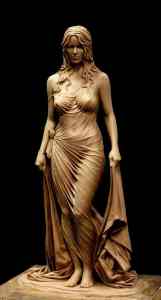
There was something refreshing about the evening air in springtime. Much of the day had been put behind her save for those last nagging thoughts that tend to linger upon uncertainty. It was the season of war, and hubris pitted nation against nation (2 Sam 11.1). Her husband was among those fighting another man’s battle for glory–taken in by the illusion that bloodshed somehow brought honor or made men great (11.11). Fool, but still, she loved him (12.3; Kensky 155). Like the evening air, the water was cool and invigorating, providing respite in the midst of a tumultuous season. She was unaware of the gaze that held her like an object to be owned or the hunger rising behind those lurid eyes (2 Sam 11.2-4). When the king’s men arrived, Bathsheba had no recourse. Hers was but to submit.

—–

The structures of power are aligned against Bathsheba. To position her as villain or vixen in the account of 2 Samuel requires leaps the text does not provide. Neither does the Hebrew provide wiggle room to frame David as the unwitting victim of feminine wiles. In the clearest (and least academic) terms, based on what is revealed in the text, Bathsheba was minding her own damn business. It is David’s lustful eyes that happen upon her private moment, and it is David who sexualizes and objectifies her body. Like Simba, who disregarded Mufasa’s warning that the dark places were not his to tread, David considers all he lays eyes upon to be his, for he is king. Therefore, he sends his messengers into the shadowlands beyond divinely established moral borders to take what does not belong to him.

David does what David does because he believes he can. He is king; who can challenge him? There is no hard evidence to prove that his audience with Bathsheba was anything more than a friendly chat. Rumors, after all, are only rumors. It is when Bathsheba becomes pregnant that things get a little more complicated. David can’t just shove $600 into her hand and tell her to “take care of it.” Instead, he does the next worst thing–he brings her husband home for a bit of r&r in the hope of hiding the truth surrounding Bathsheba’s condition. When that doesn’t work, the king murders her husband by proxy.

What transpires between Bathsheba and David is a sexual assault. Regardless of how force, intimidation, or coercion may have been used, the encounter remains an assault. From the moment the male gaze of David falls upon her, Bathsheba’s life is in danger. She cannot refuse the king, for he can put her to death (or worse). If her husband discovers she is pregnant and he a cuckold, he can put her to death to restore his fragile honor. The power differential is far too vast for Bathsheba to cross safely.

Bathsheba is damned if she does and damned if she doesn’t. Her personhood is violated by a prick in a crown. She has no earthly means of getting the justice due her. Her assault and the murder of her husband go unresolved because the structural powers are set against her. Yet, the unfathomable injury against her does not go unanswered. The Divine Creator of the universe sees the harm brought against the “least of these” (Mt 25.31-46) and is enraged. Bathsheba, bearing the imago dei, has been grossly injured and God is not having it–not today, anyway.

—–

This divine intervention reveals that our sacred cows do not always get it right–they don’t even get it mostly right. Yet, because we do not want to critique our idols, we miss what is happening before us. To frame this story as “what you do doesn’t matter as long as you love God” is to miss Bathsheba. The man after God’s own heart inflicts undue trauma on her. As Tikva Frymer-Kensky suggests in Reading Women of the Bible, Bathsheba–and not her husband–is the poor man whose lamb is taken and slaughtered (155). The “thing that David had done displeased the Lord” (2 Sam 11.27) and he is held accountable.

God loves Bathsheba. Though her society makes her lesser because of her gender and renders her male property, the Creator’s action casts her in a different light. The Divine brings judgment down on the king’s head for her. Her personhood and dignity matter. She bears the same imago dei as her male counterparts. God equally loves her.

This divine act almost seems to foreshadow the coming Christ, who will fulfill the Law and tear down the barriers erected to segregate us from each other–in whom there is no distinction between “us” and “them.” Certainly, this should call to mind the foundation of the Law and Prophets–to love God with all we are, and to love the human beings around us as we ought love ourselves (Mt 22.36-40) regardless of the segregating barriers culture would have us erect. BIPOC, LGBTQIA+, female, male, poor, rich, homeless, disabled, white, cisgender, heteronormative, non-heteronormative, and everything in between, in Christ, we are one, and by our love we will be judged (Mt 25.31-46).

Perhaps, then, it is imperative that we strive to see the overlooked among us—for regardless of our own perceived standing before God, we will be held to account where we withheld love in favor of cruelty and self satisfaction.

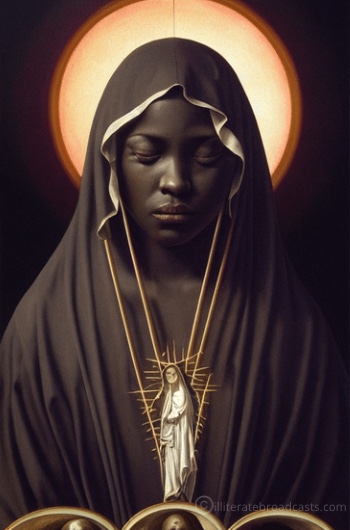
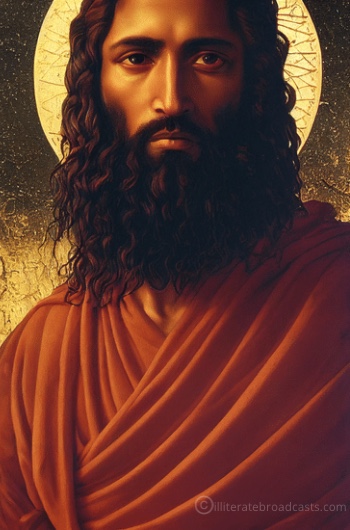
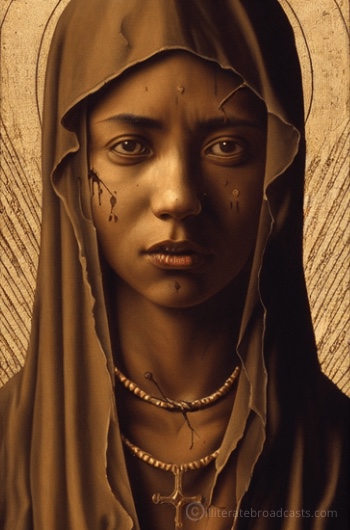
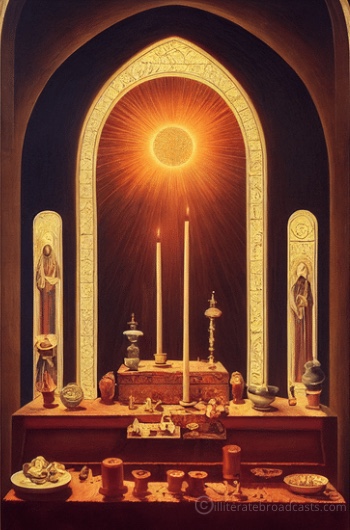
Reimagining the Sacred through AI Generated Art

Brewer, Michael. “Jesus of Nazareth.” Midjourney AI, Digital Medium, 2022.
Brewer, Michael. “Our Lady of Sorrows.” Midjourney AI, Digital Medium, 2022.
Brewer, Michael. “Mary Magdalene.” Midjourney AI, Digital Medium, 2022.
Brewer, Michael. “St. Monica.” Midjourney AI, Digital Medium, 2022.
Brewer, Michael. “Holy Eucharist.” Midjourney AI, Digital Medium, 2022.

The Four-Fold Franciscan Blessing by The Very Rev. Kim L. Coleman.

And now, may God bless us with anger at injustice, oppression, exploitation of people, so that we may continue to work for justice, freedom and peace. Amen.

May God bless us with tears to shed for those who suffer from pain, rejection, starvation and war, so that we may reach out our hand to comfort them and to turn their pain into joy. Amen.

May God bless us with enough foolishness to believe that we can make a difference in this work, so that we can do what others claim cannot be done. Amen.

And the Blessings of God Almighty, the One who creates, Redeems and Sanctifies, be upon you and all you love, this day, and forever more. Amen.

The Four-Fold Franciscan Blessing, The Very Rev. Kim L. Coleman.

Parenting From Trauma

Raising my kids, I can’t help but think about all those in my past that I’m disappointing by treating my children as growing independent human beings. We communicate, work through our thoughts and feelings, we practice empathy, and we have both our good and bad days.

By removing the “I win, you lose” element practiced by my parents’ generation, acknowledging my failures and faults, and apologizing (I still suck at this) when I screw up, I find my children are learning how to both communicate and be empathetic towards others. They are growing up saying “asshole,” yes, but they are not growing up to be assholes.

And that, as far as I’m concerned, is holy.